Is Bread Ultra-Processed? White, Whole Wheat & Sourdough Explained
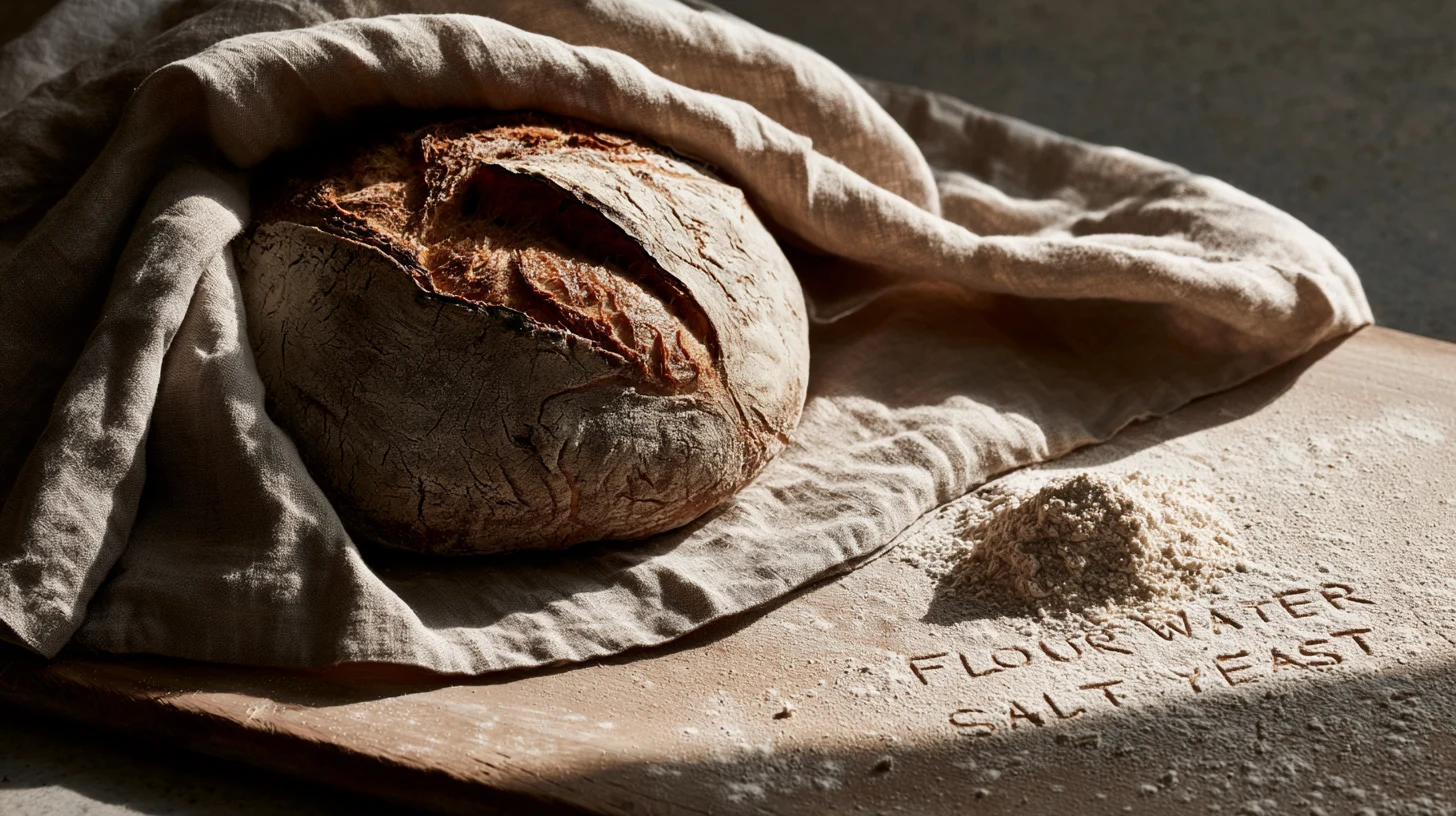
Authentic sourdough made with just flour, water, salt, and a live culture — no additives required.
Bread feels like a basic food. Flour, water, yeast, salt — what could be more natural? But walk down any supermarket bread aisle and you'll find ingredient lists stretching across the entire back of the bag: dough conditioners, emulsifiers, preservatives, added sugars, and a string of chemicals you'd never use in a home kitchen.
The short answer: most commercial bread is ultra-processed, classified as NOVA Group 4 — the highest level of industrial food processing. That includes most white bread, most whole wheat bread, many multigrain loaves, and virtually all packaged sliced bread. But not all bread is the same, and the distinction matters for your health.
Here's exactly how to tell whether the bread you're eating is ultra-processed, what ingredients are the red flags, and which options are genuinely minimally processed.
What the NOVA Classification Says About Bread
The NOVA system, developed by researchers at the University of São Paulo, classifies foods into four groups based on the extent and purpose of industrial processing — not on nutrient content.1 A food can be nutritionally poor and still be NOVA Group 1, or nutritionally rich and still be NOVA Group 4.
For bread, NOVA draws a clear line based on ingredients:
-
NOVA Group 2 — Processed culinary ingredient: Flour itself. Ground from whole grain, refined or not — flour is a processed ingredient used to cook with.
-
NOVA Group 3 — Processed food: Bread made from flour, water, yeast, and salt. Nothing else. Traditional bread, artisan sourdough, and homemade loaves typically fall here.
-
NOVA Group 4 — Ultra-processed food: Bread containing emulsifiers, preservatives, dough conditioners, flavor enhancers, added sugars beyond a small amount, or isolated proteins. The vast majority of packaged sliced bread sold in supermarkets.
Key rule: If a bread's ingredient list contains anything beyond flour, water, yeast, salt, and perhaps a small amount of oil or sugar, you are almost certainly looking at a NOVA Group 4 ultra-processed product.
Is White Bread Ultra-Processed?
Yes — almost always. Commercial white bread is one of the most common ultra-processed foods in the average diet. A typical supermarket white loaf contains not just flour, water, yeast, and salt, but a cocktail of additives designed to extend shelf life, improve texture, and accelerate industrial production.
A standard commercial white bread might list: enriched wheat flour, water, high fructose corn syrup, soybean oil, yeast, salt, calcium propionate (preservative), DATEM (dough conditioner), sodium stearoyl lactylate, monoglycerides, soy lecithin, and added vitamins. That's 14+ ingredients for what should be a four-ingredient food.
Each additive serves an industrial purpose:
- High fructose corn syrup — sweetener that also accelerates browning
- DATEM (diacetyl tartaric acid esters of mono- and diglycerides) — emulsifier that strengthens dough and improves volume
- Calcium propionate — mold inhibitor extending shelf life to weeks
- Sodium stearoyl lactylate — emulsifier that softens crumb texture
- Monoglycerides and diglycerides — additional emulsifiers for consistent texture at scale
None of these additives appear in bread you'd bake at home. Their presence is what defines a bread as ultra-processed under NOVA — not the whiteness of the flour, and not the calorie or sugar content.
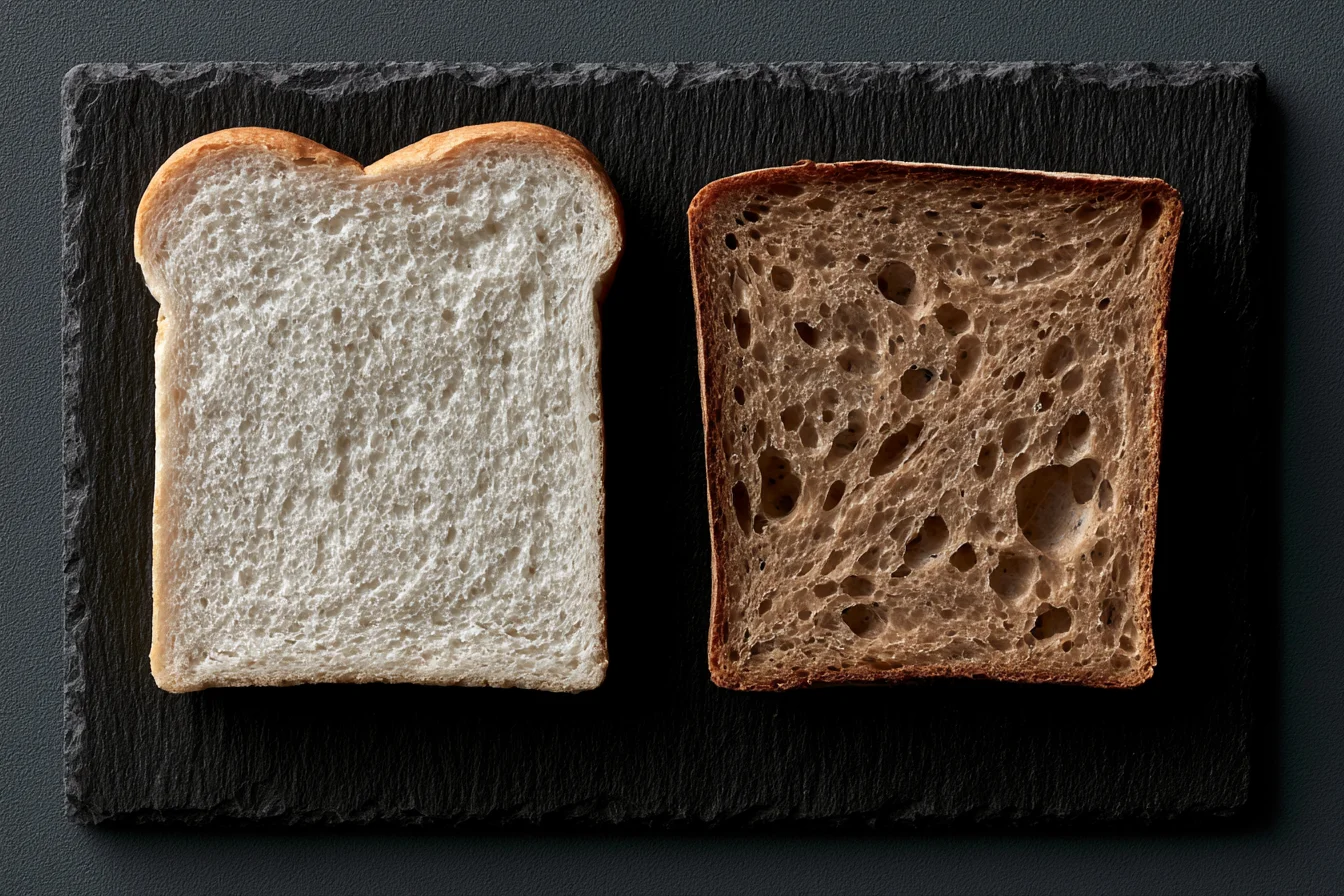
Commercial white bread (left) vs. authentic sourdough (right) — visually similar, but worlds apart in processing level.
Is Whole Wheat Bread Ultra-Processed?
Usually, yes — and this surprises many people. Whole wheat bread is widely perceived as the healthier choice, and from a fiber and micronutrient standpoint, it often is. But the NOVA classification doesn't grade on nutrition. It grades on industrial processing.
Most commercially produced whole wheat bread contains the same emulsifiers, preservatives, and dough conditioners as white bread — just with whole wheat flour substituted in. The ingredient list may be slightly shorter, but it frequently still includes DATEM, calcium propionate, mono- and diglycerides, and added sugars. That's enough to classify it as NOVA Group 4.
Additionally, many "whole grain" breads contain added vital wheat gluten — an isolated protein added to improve the structure of doughs that use heavier whole grain flours. Isolated proteins are a hallmark NOVA Group 4 ingredient.
The label trap: "100% whole grain," "multigrain," "12-grain," and "made with whole wheat" are marketing claims about flour type — not processing level. A bread can be 100% whole grain and still be ultra-processed if it contains industrial additives.
Is Sourdough Ultra-Processed?
Traditional sourdough is one of the few commercially available breads that can genuinely be NOVA Group 3. Authentic sourdough is made from just flour, water, salt, and a live fermentation culture (wild yeast and bacteria). No emulsifiers, no preservatives — the fermentation process itself extends shelf life and creates a complex flavor profile.
However, "sourdough" has become a marketing term rather than a production method. Many supermarket sourdoughs are produced industrially using rapid-rise yeast rather than genuine slow fermentation, with added vinegar or citric acid to create the sour flavor and the same roster of dough conditioners and preservatives as any other commercial loaf. In these cases, the label says sourdough, but the product is NOVA Group 4.
To identify genuine sourdough, the ingredient list should contain: flour, water, salt, and a sourdough culture (or "levain"). If you see added yeast alongside "sourdough culture," or any emulsifiers and preservatives, you're looking at an industrial imitation.
The Bread Ingredients That Signal Ultra-Processing
Reading a bread label takes less than a minute, and a handful of specific ingredients reliably indicate NOVA Group 4 status. Avoid or limit breads containing:
- Emulsifiers: DATEM, mono- and diglycerides, sodium stearoyl lactylate (SSL), soy lecithin, polysorbate 60
- Preservatives: Calcium propionate, potassium sorbate, sodium benzoate
- Dough conditioners: Azodicarbonamide (ADA), ascorbic acid (in commercial quantities), l-cysteine
- Isolated proteins: Vital wheat gluten, soy protein isolate, whey protein
- Industrial sweeteners: High fructose corn syrup, corn syrup, invert sugar syrup
- Artificial flavors listed generically
A bread with any one of these in its ingredient list qualifies as ultra-processed under the NOVA framework. Most commercial loaves contain three or more.
Not Sure About Your Bread? Scan the Barcode.
UPF Detector instantly classifies any packaged food by its NOVA group. Scan your bread's barcode to see whether it's ultra-processed and exactly which ingredients triggered the classification.
Why Does It Matter If Bread Is Ultra-Processed?
Research consistently links high ultra-processed food consumption to adverse health outcomes. A landmark NIH randomized controlled trial found that participants assigned to an ultra-processed diet consumed an average of 508 extra calories per day compared to those on an unprocessed diet — with no deliberate effort to overeat.2 The effects on body weight, appetite hormones, and eating speed were significant even over just two weeks.
Large observational studies from France found that a 10% increase in the proportion of ultra-processed foods in the diet was associated with a 12% higher cancer risk3 and significant increases in cardiovascular disease risk.4
Bread consumed daily, across every meal, adds up quickly. If every slice of toast at breakfast, every sandwich at lunch, and every dinner roll is ultra-processed, bread alone becomes a substantial UPF burden in an otherwise reasonable diet. Switching to genuinely minimally processed bread — or reducing consumption — is one of the higher-impact changes available because of how frequently bread appears in meals.
How to Find Non-Ultra-Processed Bread
Non-ultra-processed bread does exist in most supermarkets, but you have to read the label rather than trust marketing claims. Here's what to look for:
The five-ingredient test
A genuinely minimally processed bread needs: flour (any type), water, yeast (or sourdough culture), salt, and optionally a small amount of oil. If the ingredient list fits on a single short line and you recognize every ingredient, it's likely NOVA Group 3. If the list runs to 15 ingredients with chemical names, it's NOVA Group 4.
Where to look
- Bakeries: Fresh-baked bread from local bakeries is usually made with minimal ingredients. Ask what's in the dough if you're unsure.
- Specialty supermarket sections: Many stores carry artisan or "clean label" bread brands in their specialty or organic sections.
- Farmer's markets: Small-batch bread producers typically use traditional methods and short ingredient lists.
- Bake your own: Homemade bread — even a simple no-knead loaf — requires only flour, water, yeast, and salt and takes about 5 minutes of active time.
Brands and packaging
Some supermarket brands have introduced genuinely clean-label loaves with short ingredient lists. The key is to read the label every time, even on brands you've used before — formulations change, and a product you bought a year ago may have a different ingredient list today.
Quick Reference: Bread Types and NOVA Classification
| Bread Type | Typical NOVA Group | Why |
|---|---|---|
| Commercial white sliced bread | Group 4 | Emulsifiers, preservatives, HFCS, dough conditioners |
| Commercial whole wheat bread | Group 4 | Same additives as white bread, often plus vital wheat gluten |
| Supermarket sourdough (industrial) | Group 4 | Added yeast, emulsifiers, acidulants mimicking real fermentation |
| Authentic artisan sourdough | Group 3 | Flour, water, salt, live culture — no additives |
| Bakery bread (simple recipe) | Group 3 | Traditional ingredients only, no industrial additives |
| Homemade bread | Group 3 | You control the ingredients — inherently minimally processed |
| Clean-label supermarket loaves | Group 3* | Depends on label — read every ingredient to confirm |
*Always verify by reading the full ingredient list. NOVA classification depends on what's in the product, not the product category.
The Bottom Line
Bread has been a staple food for thousands of years. The version most of us eat today is not the same product — it's an industrially engineered food designed for long shelf life, consistent texture, and low production cost. The NOVA framework makes this distinction visible in a way that calorie counts and nutrition labels don't.
Most commercial white bread, whole wheat bread, and supermarket sourdough is ultra-processed. Genuinely minimally processed bread exists, but you have to read the label to find it. The ingredient list is the only reliable guide — short lists with recognizable ingredients indicate NOVA Group 3, long lists with chemical additives indicate NOVA Group 4.
You don't have to give up bread. You just need to know which bread you're actually eating.
Scan any packaged bread to see its NOVA classification instantly.
Download UPF DetectorReferences
- 1. Monteiro, C.A., Cannon, G., Levy, R.B., Moubarac, J.C., Louzada, M.L., Rauber, F., Khandpur, N., Cediel, G., Neri, D., Martinez-Steele, E., Baraldi, L.G., & Jaime, P.C. (2019). "Ultra-processed foods: what they are and how to identify them." Public Health Nutrition, 22(5):936–941.
- 2. Hall, K.D., Ayuketah, A., Brychta, R., Cai, H., Cassimatis, T., Chen, K.Y., Chung, S.T., Costa, E., Courville, A., Darcey, V., Fletcher, L.A., Forde, C.G., Gharib, A.M., Guo, J., Howard, R., Joseph, P.V., McGehee, S., Ouwerkerk, R., Raisinger, K., … Zhou, M. (2019). "Ultra-Processed Diets Cause Excess Calorie Intake and Weight Gain: An Inpatient Randomized Controlled Trial of Ad Libitum Food Intake." Cell Metabolism, 30(1):67–77.e3.
- 3. Fiolet, T., Srour, B., Sellem, L., Kesse-Guyot, E., Allès, B., Méjean, C., Deschasaux, M., Fassier, P., Latino-Martel, P., Beslay, M., Hercberg, S., Lavalette, C., Monteiro, C.A., Julia, C., & Touvier, M. (2018). "Consumption of ultra-processed foods and cancer risk: results from NutriNet-Santé prospective cohort." BMJ, 360:k322.
- 4. Srour, B., Fezeu, L.K., Kesse-Guyot, E., Allès, B., Méjean, C., Andrianasolo, R.M., Chazelas, E., Deschasaux, M., Hercberg, S., Galan, P., Monteiro, C.A., Julia, C., & Touvier, M. (2019). "Ultra-processed food intake and risk of cardiovascular disease: prospective cohort study." BMJ, 365:l1451.